
In an era defined by remote work, multi-cloud deployments, and sophisticated cyber threats, the traditional security perimeter is officially obsolete. Organizations can no longer rely on the classic “castle-and-moat” strategy, which assumed that anything sitting inside an internal network boundary was safe.
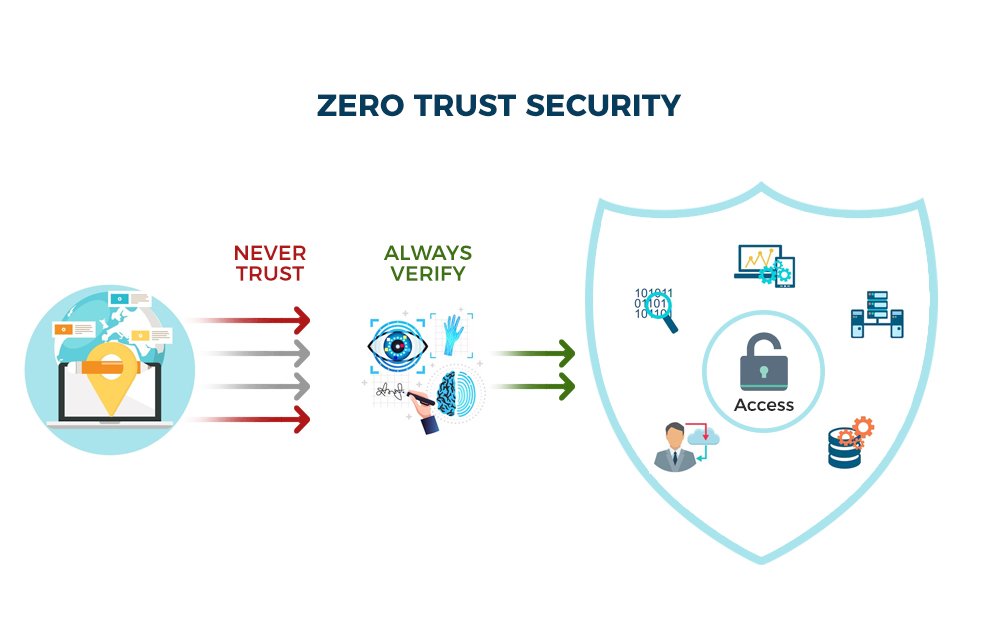
Zero Trust Architecture (ZTA) is a strategic cybersecurity framework designed to eliminate implicit trust. Built on the core ethos of “never trust, always verify,” Zero Trust requires continuous authentication, authorization, and validation of every user, device, and network request regardless of location.
The Sunset of Perimeter-Based Security
For decades, enterprise security relied on physical and virtual perimeters. Once an employee logged into the corporate network—either on-site or via a Virtual Private Network (VPN)—they were granted broad access to internal resources.
This approach creates a catastrophic single point of failure:
-
Lateral Movement: If an attacker steals a single employee’s credentials, they gain unmonitored access to pivot laterally across servers, databases, and internal tools.
-
Cloud Expansion: Modern assets live across public clouds (AWS, Azure, GCP), SaaS applications (Microsoft 365, Salesforce), and edge devices—making a single perimeter impossible to define.
Traditional Security: "Castle-and-Moat"
[ External Threat ] ──► ( Perimeter Firewall ) ──► [ Internal Network: Everything Implicitly Trusted ]

Zero Trust Architecture: Resource-Centric Control
[ User / Device ] ──► ( Policy Decision Point ) ──► ( Policy Enforcement ) ──► [ Isolated Micro-Segmented Asset ]
Core Tenets of Zero Trust (NIST SP 800-207)
The National Institute of Standards and Technology (NIST) formalizes Zero Trust Architecture through SP 800-207. ZTA operates under three non-negotiable principles:
-
Verify Explicitly: Always authenticate and authorize based on all available data points—including user identity, real-time location, device health, service workload, and data classification.
-
Use Least Privilege Access: Limit user permissions with Just-In-Time (JIT) and Just-Enough-Access (JEA) policies, granting only the absolute minimum access required to complete a specific task.
-
Assume Breach: Design networks under the assumption that adversaries are already inside the environment. Minimize the “blast radius” by segmenting access, encrypting all end-to-end sessions, and continuously monitoring system analytics.
Architectural Pillars of Zero Trust
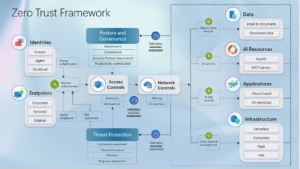
Building a mature Zero Trust environment requires orchestrating security controls across six foundational domains:
-
Identity: Relying on strong Identity and Access Management (IAM), passwordless Multi-Factor Authentication (MFA), and context-aware single sign-on. Identity becomes the new primary security perimeter.
-
Endpoints: Verifying device posture—such as patch status, Endpoint Detection and Response (EDR) agent health, and disk encryption—before granting access.
-
Networks & Microsegmentation: Replacing flat corporate networks with software-defined micro-perimeters to prevent unauthorized lateral movement.
-
Applications & Workloads: Applying Zero Trust Network Access (ZTNA) policies to securely isolate individual cloud microservices, APIs, and enterprise applications.
-
Data: Encrypting data at rest and in transit while deploying Data Loss Prevention (DLP) tools to control how sensitive files are shared.
-
Visibility & Analytics: Leveraging automated SIEM/SOAR platforms to process real-time telemetry, detect behavioral anomalies, and dynamically revoke compromised credentials.
Traditional Security vs. Zero Trust Architecture
| Dimension | Traditional Perimeter Model | Zero Trust Architecture |
| Trust Model | Implicit trust based on network location | Zero implicit trust; continuous verification |
| Primary Gatekeeper | Network Firewalls & VPNs | Identity (IAM) & Contextual Policy Engine |
| Network Layout | Flat internal network | Microsegmentation and isolated enclaves |
| Access Verification | Performed once at network login | Performed dynamically per request and per session |
| Breach Impact | High risk of wide-scale lateral movement | Minimal blast radius due to strict segmentation |
Key Benefits and Implementation Challenges
Primary Benefits
-
Dramatically Reduces Breach Risk: By requiring explicit verification for every access attempt, credential-based attacks and social engineering lose their ability to compromise entire networks.
-
Enables Secure Distributed Work: Employees and contractors can access business apps securely from anywhere without routing all traffic through slow VPN concentrators.
-
Accelerates Regulatory Compliance: Granular access controls, comprehensive audit logging, and automated policy enforcement simplify adherence to frameworks like SOC 2, ISO 27001, and HIPAA.
Implementation Hurdles
-
Legacy Systems: Older on-premises applications often lack native support for modern API-driven identity controls or MFA, requiring gateway wrappers.
-
Operational Complexity: Migrating to Zero Trust requires careful mapping of data flows and dependencies; overly aggressive segmentation rules can disrupt legitimate employee workflows.
Zero Trust Architecture is not a single product you purchase—it is an operational strategy and security posture. By systematically stripping away implicit trust, organizations can protect their digital assets against credential theft, insider threats, and sophisticated cyberattacks.