
For years, building a smart home meant navigating a fragmented landscape of competing standards. Smart bulbs, plugs, locksets, and sensors from different manufacturers often required proprietary hubs, separate apps, and custom integrations to work together.
The Matter protocol solves this fragmentation by establishing a unified, royalty-free connectivity standard created by the Connectivity Standards Alliance (CSA) in partnership with tech giants like Apple, Google, Amazon, and Samsung.
1. What Is the Matter Protocol?
Matter is an open-source application layer standard designed to ensure smart home devices, mobile apps, and cloud services communicate seamlessly regardless of brand.
2. Core Pillars of Matter Architecture
Universal IP Connectivity
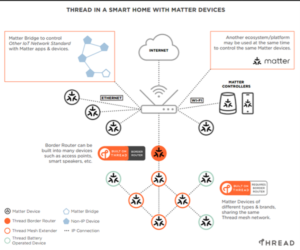
Matter operates on top of standard Internet Protocol (IP) networking technologies. It does not replace low-level transport mechanisms like Wi-Fi or Ethernet; instead, it runs as a shared software protocol across them:
-
Wi-Fi / Ethernet: Used for high-bandwidth endpoints like smart TVs, streaming hubs, and video cameras.
-
Thread: A low-power, self-healing IPv6 mesh network protocol designed for battery-operated accessories like door sensors, smart locks, and light switches.
-
Bluetooth Low Energy (BLE): Utilized exclusively for initial device onboarding and setup.
Local Control & Independence
Unlike legacy smart home setups that route commands through external cloud servers, Matter processes communications locally on your home network. When you turn on a light using a voice assistant or mobile app:
-
The control signal travels over local Wi-Fi or Thread straight to the light bulb.
-
The action executes with ultra-low latency (< 100ms).
-
Operations continue uninterrupted even if your home loses internet connectivity.
3. Key Features Transforming the Smart Home
Multi-Admin Functionality
Multi-Admin allows a single Matter-certified device to connect to multiple smart home ecosystems simultaneously. You can pair a single smart plug with Apple Home, Google Home, Amazon Alexa, and Samsung SmartThings without resetting or unpairing it.
                         Multi-Admin Architecture

                           ┌────────────────────────┐
                           │    Matter Smart Plug   │
                           └───────────┬────────────┘
                                       │
            ┌──────────────────────────┼──────────────────────────┐
            ▼                          ▼                          ▼
  ┌───────────────────┐      ┌───────────────────┐      ┌───────────────────┐
  │ Apple Home App    │      │ Google Home App   │      │ Amazon Alexa App  │
  │ (Local IP Stream) │      │ (Local IP Stream) │      │ (Local IP Stream) │
  └───────────────────┘      └───────────────────┘      └───────────────────┘
End-to-End Security
Every Matter device employs public key cryptography to authenticate its identity during onboarding. AES-128 encryption secures all data exchanges across local networks, preventing unauthorized network snooping or rogue device impersonation.
4. Architectural Comparison: Legacy Smart Home vs. Matter
| Feature | Legacy Smart Home | Matter Smart Home |
| Primary Connection | Cloud-to-Cloud APIs / Proprietary Hubs | Local IPv6 Direct Communication |
| Interoperability | Ecosystem lock-in (e.g., Works with Alexa only) | Universal multi-admin support across brands |
| Offline Capability | Limited or broken without active internet | Full local control without active cloud links |
| Setup Process | Custom brand apps and account sign-ups | Unified QR code scanning via native OS apps |
| Network Fabric | Fragmented Wi-Fi and Zigbee bridges | Unified Wi-Fi, Ethernet, and Thread mesh |
5. How Thread Border Routers Fit In
Because Matter runs across both Wi-Fi and Thread networks, Thread Border Routers serve as essential bridges. A Thread Border Router links the low-power Thread mesh network to your main local Wi-Fi/Ethernet router.
-
Integrated Border Routers: Many modern smart speakers and hubs—such as Apple HomePod mini, Google Nest Hub (2nd Gen), and Amazon Echo (4th Gen)—contain built-in Thread Border Routers.
-
Seamless Fabric: Adding a Thread-enabled device extends the range of your entire smart home mesh without installing standalone proprietary hubs.
6. Current Capabilities and Future Roadmap
While Matter covers essential core categories, its specification continually expands to support broader smart home infrastructure:
-
Currently Supported: Lighting, smart plugs, switches, door locks, thermostats, blinds/shades, media players, HVAC units, robot vacuums, and energy management monitors.
-
Expanding Standards: Ongoing updates incorporate enhanced support for home security cameras, EV chargers, complex home appliances, and health sensors.