

Artificial intelligence has permanently altered the cybersecurity landscape, creating a high-speed technological arms race between cybercriminals and defense teams. Generative AI, Large Language Models (LLMs), and machine learning pipelines are now deployed on both sides of the perimeter—automating attacks at unprecedented scale while empowering security operations centers (SOCs) to neutralize threats in real time.
AI as an Offensive Weapon: Modern Cyberattack Tactics
Cybercriminals leverage AI to automate reconnaissance, bypass traditional security filters, and scale personal targeting.
Offensive AI Tactics

[ Automated Vulnerability Discovery ] ──► AI agents scan repositories to find zero-day flaws.
[ Hyper-Personalized Phishing ] ───────► LLMs craft context-aware emails mimicking exact tone.
[ Deepfake Voice & Video Impersonation ]► Generative audio clones executives for wire fraud.
[ Polymorphic & Adaptive Malware ] ────► AI rewrites malware binaries on the fly to evade EDR.
-
Hyper-Personalized Spear Phishing: Attackers use LLMs to analyze public social media profiles, press releases, and stolen corporate communications to craft highly tailored, grammatically flawless emails that easily bypass traditional spam filters.
-
Deepfake Audio and Video Extortion: Generative voice-cloning models allow threat actors to clone an executive’s voice using just a few seconds of audio, executing sophisticated Business Email Compromise (BEC) and wire-transfer fraud over live phone or video calls.
-
Polymorphic and Adaptive Malware: AI-assisted malware can dynamically modify its underlying code structure while maintaining its core payload, effectively evading traditional signature-based Endpoint Detection and Response (EDR) systems.
-
Automated Exploit Generation: Autonomous vulnerability scanners powered by LLMs analyze open-source repositories and compiled binaries to identify unpatched security flaws and write working exploits faster than human security teams can deploy patches.
AI as a Defensive Shield: Modern Cybersecurity Safeguards
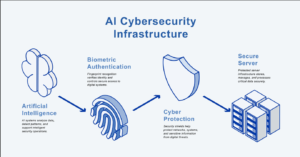
To match the speed and scale of AI-driven attacks, enterprise security operations rely on machine learning models to detect anomalies and automate incident response.
-
Behavioral Anomaly Detection: Security Information and Event Management (SIEM) systems use machine learning to establish a baseline of normal user and network behavior. Any sudden deviation—such as an employee logging in from an unusual location at 3 AM and downloading gigabytes of sensitive files—triggers immediate containment.
-
Automated Incident Response (SOAR): Security Orchestration, Automation, and Response (SOAR) platforms use AI playbooks to automatically isolate compromised laptops, revoke compromised credentials, and block malicious IP addresses across firewalls in milliseconds.
-
Predictive Threat Intelligence: AI algorithms ingest millions of global threat indicators in real time to predict potential attack vectors, allowing security teams to patch vulnerabilities before they are actively exploited in the wild.
-
AI-Powered Code Auditing: Automated static and dynamic analysis tools scan application code during development, flagging security flaws, hardcoded credentials, and logic bugs directly inside developer workflows.
Offensive AI vs. Defensive AI Comparison
| Feature / Domain | Offensive AI (Attacker Capabilities) | Defensive AI (Security Operations) |
| Primary Goal | Bypassing perimeter controls and exfiltrating data | Detecting intrusions and automating threat containment |
| Operational Speed | Executes rapid, parallelized reconnaissance scans | Analyzes telemetry and responds to alerts in milliseconds |
| Phishing Strategy | Generates personalized, multi-channel social engineering | Detects semantic anomalies and domain spoofing in real time |
| Malware Strategy | Mutates code signatures to evade static detection rules | Uses behavioral analysis to block malicious process execution |
| Human Involvement | Low; automated bots handle campaign execution | Medium; AI assists SOC analysts in triaging high-priority alerts |
The Future: Autonomous Cyber Warfare and Governance
As AI models evolve, security operations are transitioning from human-led, AI-assisted monitoring to autonomous cyber defense systems. Human analysts can no longer evaluate millions of log events manually per second; instead, defensive AI agents will independently hunt threats, reconfigure network policies, and neutralize active breaches.
To maintain resilience, organizations must adopt Zero Trust Architecture, deploy robust identity verification controls (such as phishing-resistant MFA and Passkeys), and continuously audit their own AI pipelines to prevent data poisoning and adversarial model manipulation.